Keeping a swimming pool clean in Florida involves much more than removing leaves from the surface or running an automatic cleaner a few times each week. The combination of year-round heat, strong sunlight, sudden rain, windblown debris, pollen, heavy swimming and long swimming seasons means Florida pools are constantly collecting material that affects both water clarity and water chemistry. Even when the water looks relatively clean, debris may be settling on steps, collecting in corners, building up in baskets or placing extra pressure on the filtration system.
A reliable maintenance routine needs to address the entire circulation and cleaning system. That includes skimming the surface, brushing walls and steps, vacuuming or using an automatic cleaner, emptying baskets, monitoring filter performance, maintaining proper circulation and making sure the pump is moving enough water through the system. These tasks work alongside water chemistry rather than separately from it. When cleaning or filtration begins to fall behind, chlorine demand may increase, algae can develop more easily and the pool may become cloudy even when chemical readings initially appear acceptable.
This guide explains how cleaning, filtration and circulation work together in a Florida pool, how often different maintenance tasks may be needed and what homeowners should watch for before routine debris turns into a larger water-quality problem. If you prefer to have cleaning, water testing and routine equipment checks handled consistently, Aqua Clear FL Pools provides weekly pool maintenance in Port St. Lucie for residential pools.
Why Florida Pools Need Consistent Cleaning and Filtration
Florida creates conditions where pool maintenance can become inconsistent very quickly if cleaning is skipped. Pools may receive leaves, grass clippings, insects, pollen and windblown dirt throughout the year. Afternoon thunderstorms can move additional debris into the water within minutes, while heavy rainfall can change water levels and chemistry at the same time. During warmer months, higher swimmer activity can introduce sunscreen, body oils and other organic material that must eventually be removed or filtered from the water.
These contaminants do not simply affect how the pool looks. Organic material consumes sanitizer, while suspended particles place additional demand on the filter. Debris that settles on surfaces can create areas where algae develops more easily, particularly when circulation is weak. When cleaning, filtration and chemistry are all slightly behind, the problem can compound until the water becomes dull, cloudy or green.
The Florida Department of Health notes that maintenance requirements can vary according to factors such as swimmer load, ultraviolet exposure, nearby vegetation, windblown debris and rainfall dilution. Although its public-pool rules are not a maintenance schedule for residential homeowners, those factors illustrate why one rigid cleaning schedule does not suit every Florida pool.
The better approach is to establish a consistent baseline while adjusting for the pool's environment. A screened pool with little surrounding vegetation may collect far less debris than an unscreened pool beneath trees, but both still need filtration, circulation and regular surface cleaning.
How Pool Cleaning, Filtration and Circulation Work Together
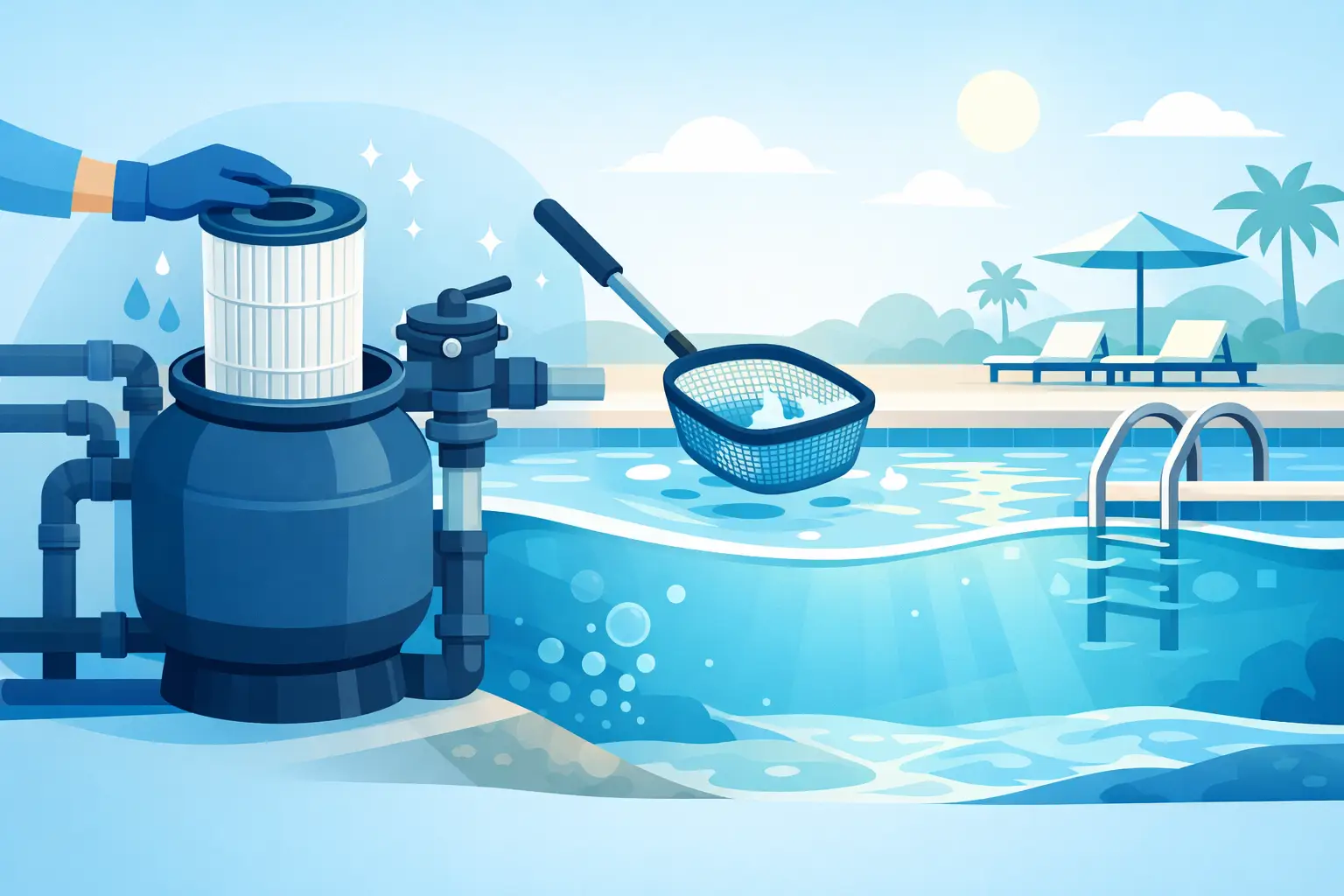
Pool cleaning is often treated as a collection of separate chores, but the entire system works together. The pump pulls water from the pool through the skimmer and other suction points, moves it through the filter and returns cleaner water through the return jets. Surface skimming and baskets remove larger material before it can travel further through the system, while the filter captures smaller suspended particles that would otherwise remain in the water.
Brushing and vacuuming perform a different job. Material that has settled on floors, walls, steps or corners cannot always reach the filtration system on its own. Brushing loosens dirt and early algae growth, while vacuuming or an automatic cleaner removes debris that has settled to the bottom.
When one part of the process is neglected, the rest of the system may have to work harder. A basket filled with leaves may restrict water flow. A dirty filter can reduce circulation. Poor circulation may allow debris and sanitizer demand to concentrate in certain areas of the pool. Weak brushing or vacuuming can leave organic material on surfaces even if the water itself appears clear.
That is why good pool maintenance should focus on maintaining the flow of water and debris through the entire system rather than simply making the visible surface look clean.
Skimming Leaves and Surface Debris
Surface skimming is one of the simplest pool-maintenance tasks, but it can prevent a surprising number of problems. Leaves, insects, seed pods, pollen and other organic material are easier to remove while they remain on the surface. Once they become waterlogged and sink, they may stain surfaces, contribute to sanitizer demand or break down into smaller material that must later be filtered out.
Florida weather makes surface debris particularly unpredictable. A pool may remain clean for several days and then collect a substantial amount of material after one storm or windy afternoon. Properties with palm trees, flowering plants or other vegetation near the pool may require even more frequent attention.
Removing large debris early also reduces the amount of material reaching the skimmer basket and pump basket. When baskets fill too heavily, water flow can be restricted, which affects circulation and filtration. For that reason, surface skimming should not be viewed as a cosmetic task alone. It is one of the first stages of protecting the circulation system.
Why Skimmer Baskets Need Regular Attention
The skimmer basket collects leaves and other larger debris before they travel further into the plumbing and filtration system. When it becomes packed with debris, the pump may struggle to pull enough water through the skimmer.
Reduced flow can affect filtration efficiency and may make it harder for treated water to circulate evenly throughout the pool. Depending on the pool's design, a heavily blocked basket may also place additional strain on the pump.
There is no single schedule that applies to every Florida pool because debris levels vary so widely. A pool surrounded by vegetation may require frequent basket checks, while a screened enclosure may reduce the amount of large debris considerably. The important habit is to inspect the basket often enough that it never remains heavily obstructed for long periods.
After storms or high winds, checking the skimmer basket should be one of the first maintenance tasks because large amounts of debris can enter the pool quickly.
The Role of the Pump Basket
The pump basket provides another layer of protection before water enters the pump and continues toward the filter. Debris that bypasses the skimmer basket or enters through other suction lines can become trapped here.
A clogged pump basket can reduce circulation just like a blocked skimmer basket. It should therefore be included in routine maintenance rather than inspected only when the pool begins having flow problems.
Before opening the pump basket, the pump should be switched off and the system handled according to the equipment manufacturer's instructions. Pool circulation equipment operates under pressure, so homeowners should not open pump or filter components while the system is running.
If water flow remains unusually weak after baskets have been cleaned, the problem may involve the filter, pump, valves or another part of the circulation system. In that situation, visit our pool equipment repair page rather than repeatedly adjusting chemicals to compensate for poor circulation.
Why Pool Walls, Steps and Corners Need Brushing
Not all dirt remains suspended in the water long enough for the filter to capture it. Fine material can settle on walls, steps, benches and the pool floor, while algae can begin growing in areas where circulation is weaker.
Brushing loosens material from these surfaces so it can be vacuumed or carried into the filtration system. It is especially useful around steps, ladders, corners, behind fixtures and other areas where water movement may be limited.
Florida's warm climate makes regular brushing particularly important because algae can develop quickly when sanitizer levels fall. A wall may begin feeling slightly slippery before the water itself turns green. Brushing during routine maintenance helps disrupt this early growth before it becomes more established.
The correct brush should be suitable for the pool surface. Different materials may require different brush types, so homeowners should follow the pool finish and equipment manufacturer's recommendations rather than assuming one brush is appropriate for every surface.
How Often Should a Florida Pool Be Brushed?
There is no universal brushing schedule that applies to every residential pool, but brushing should form part of the regular maintenance routine rather than being reserved for visible algae.
Weekly brushing is a practical baseline for many pools, particularly around steps, corners and areas where circulation is weaker. Some pools may require more frequent attention after storms, heavy swimmer use or visible debris accumulation.
Pools experiencing an active algae problem may require a more intensive treatment and brushing schedule than routine maintenance. In those situations, simply brushing more often without correcting sanitizer, circulation or filtration problems is unlikely to provide a lasting solution.
If algae repeatedly appears despite normal cleaning, read our Florida pool algae prevention guide or learn more about pool algae removal when the problem has already become established.
Vacuuming and Cleaning the Pool Floor
Debris that sinks to the bottom of the pool cannot always be removed effectively through normal filtration. Sand, dirt, leaves and other material can collect on the pool floor, particularly in areas where circulation is weaker.
Manual vacuuming, automatic suction cleaners, pressure cleaners and robotic cleaners can all help remove this material. The best system depends on the pool design, equipment and type of debris commonly entering the water.
Automatic cleaners can significantly reduce manual work, but they do not eliminate the need for inspection and maintenance. Corners, steps and other difficult areas may still require attention, while cleaner bags, baskets or filters need to be emptied or cleaned according to the manufacturer's instructions.
The goal is not necessarily to vacuum according to an inflexible calendar. Instead, the floor should be cleaned often enough that visible debris does not remain for extended periods. During Florida's rainy or windy periods, that may mean additional cleaning between normal weekly maintenance visits.
Why Pool Filters Matter So Much
The filter is responsible for removing smaller suspended particles that cannot be collected through skimming or baskets alone. Without effective filtration, fine debris remains in the water, reducing clarity and potentially increasing the load on the sanitizer.
A filter should not be judged simply by whether water is still moving through it. As debris accumulates inside the filter media, resistance increases and flow can gradually decline. The pool may still circulate, but filtration performance can become less efficient.
This is why filter condition should be monitored rather than waiting until the water becomes visibly cloudy. Filter pressure, flow from the return jets and the condition of the water can all provide useful clues.
Florida Department of Health material for public pools emphasises that pumps and filters need to remain clean, properly sized and operable at their intended flow rate. Although residential pools operate under different requirements, the basic principle applies equally well: filtration depends on adequate water movement through a functioning filter.
The Main Types of Residential Pool Filters
Most residential pools use one of three general filter types: cartridge, sand or diatomaceous earth, commonly called DE. Each type removes debris differently and requires a different maintenance process.
Cartridge filters contain pleated filter elements that trap material as water passes through them. They are removed periodically and cleaned rather than backwashed in the same way as a sand filter.
Sand filters move water through a bed of filter sand that captures particles. When the filter accumulates enough debris, the flow direction is reversed during a backwash cycle to flush the trapped material out through the waste line.
DE filters use a very fine filtration medium supported by grids or other internal elements. Maintenance procedures vary according to the system, and the filter needs to be recharged correctly after cleaning or backwashing.
Because these filter systems operate differently, homeowners should follow the manufacturer's guidance for their specific equipment instead of applying a single cleaning method to every filter.
How Often Should You Clean a Pool Filter in Florida?
A filter should generally be cleaned based on its condition and operating pressure rather than on a calendar alone. The amount of debris reaching the filter depends on the pool's environment, swimmer load, cleaner type, surrounding vegetation and weather.
One useful reference is the clean operating pressure recorded after the filter has been thoroughly serviced. As debris accumulates, pressure typically rises. When the filter reaches the manufacturer's recommended pressure increase above its clean baseline, it is time for maintenance.
CDC Model Aquatic Health Code guidance for cartridge filtration recommends cleaning or replacing cartridge elements when the pressure differential across the filter reaches approximately 10 psi, while also emphasising that manufacturer instructions should be followed.
For residential pools, the exact trigger can vary by equipment, so the manufacturer's specified pressure range should take priority. Cleaning simply because a certain number of weeks have passed may be unnecessary for one pool and too infrequent for another.
We cover this topic more specifically in our guide on how often to clean a pool filter in Florida.
Cleaning Cartridge Pool Filters
Cartridge filters need more than a quick rinse when they have accumulated oils and debris. The cartridges contain pleats that create a large filtration surface, and material can become trapped deep between those pleats.
Routine cleaning typically involves shutting down the equipment safely, relieving pressure according to the manufacturer's procedure, removing the cartridges and rinsing them thoroughly. High-pressure washing is generally not appropriate because excessive pressure can damage the filter material.
CDC guidance specifically advises against using a pressure washer on cartridge filters because excessive pressure can force dirt into the media and damage the cartridge. It also notes that oils from swimmers, sunscreen and other contaminants can coat the filter and reduce performance.
Cartridges should also be inspected while they are removed. Cracked end caps, torn pleats, flattened material or other significant deterioration may indicate that cleaning alone is no longer sufficient.
When Does a Cartridge Filter Need Replacement?
Cartridge filters do not last indefinitely. Over time, repeated use and cleaning can reduce their ability to recover normal flow.
Signs that replacement may be needed include damaged pleats, cracking, a cartridge that no longer cleans effectively or filter pressure that rises again unusually soon after cleaning. Persistent water-quality problems despite normal chemistry and adequate circulation may also justify inspecting the cartridge more closely.
Replacement intervals vary widely because pool use, filter size, maintenance quality and environmental conditions differ. A heavily used pool with a small filtration system may wear cartridges more quickly than a lightly used pool with an appropriately sized filter.
Rather than replacing cartridges according to age alone, evaluate their physical condition and how well the system performs after cleaning.
How Sand Filters Are Cleaned
Sand filters are normally cleaned through backwashing. During this process, water flows through the filter in the opposite direction and carries accumulated debris out through the waste line.
Backwashing is useful, but it should not be performed unnecessarily. A filter that is backwashed too frequently may lose some of the beneficial filtration effect created as a small amount of debris builds within the sand bed. On the other hand, waiting too long can allow pressure to rise and circulation to decline.
The pressure gauge and manufacturer instructions provide a more reliable trigger than an arbitrary weekly backwash routine. If pressure has increased significantly from the clean baseline or flow has declined, backwashing may be appropriate.
Because valves need to be moved through specific positions, the pump should be switched off before changing multiport-valve settings. Homeowners unfamiliar with the procedure should follow the manufacturer's instructions closely.
Our dedicated guide on how to backwash a sand filter safely provides the procedure in greater detail.
Do Sand Filters Need More Than Backwashing?
Backwashing removes much of the debris captured by a sand filter, but it does not mean the system will never require additional maintenance.
Over time, the sand may develop channels, accumulate oils or become less effective. Internal components can also deteriorate, which may allow sand to return to the pool or reduce filtration performance.
If the filter repeatedly develops high pressure, fails to clear cloudy water despite otherwise normal conditions or sends filter material into the pool, a more detailed inspection may be necessary.
Homeowners should avoid assuming that every water-clarity issue is caused by old filter sand. Poor chemistry, circulation problems, an undersized system or other equipment issues can produce similar symptoms.
Maintaining a DE Pool Filter
DE filters can provide very fine filtration, but they need to be maintained according to their specific design. Backwashing or cleaning removes the old DE material, and the filter must then be recharged correctly with the appropriate amount of new media.
Using too little or too much DE can interfere with performance. Internal grids or elements may also need periodic cleaning and inspection.
Because DE is a fine material and waste disposal requirements can vary, homeowners should follow equipment instructions and local requirements carefully. Improper handling can create unnecessary mess or damage the system.
If you are not familiar with servicing a DE filter, professional maintenance may be preferable to guessing at the correct cleaning and recharge process.
Understanding Pool Filter Pressure
The pressure gauge is one of the most useful tools on the filtration system, but only if you know what normal looks like for your pool.
After the filter has been thoroughly cleaned and the system is operating normally, note the pressure reading. This becomes your clean baseline. As the filter captures debris, pressure often rises because water has to work harder to pass through the filter.
A significant increase above the clean baseline can indicate that the filter needs cleaning or backwashing. However, high pressure can also be connected to restricted return flow or other system issues, while unusually low pressure may indicate restricted suction, low water level, clogged baskets or pump problems.
For this reason, the gauge should be used as a diagnostic tool rather than interpreted in isolation.
Why Circulation Is Essential for a Clean Pool
Filtration only works when water reaches the filter. Good circulation moves water from different parts of the pool through the filtration and treatment system and then distributes treated water back across the pool.
Poor circulation can create areas where debris settles, sanitizer levels are less consistent and algae can develop more easily. Corners, steps and other low-flow areas may require additional brushing even when the main circulation system is working correctly.
Return jets should provide noticeable water movement, while skimmers should continuously draw surface water when the pump is running. A sudden decrease in either can indicate a problem somewhere in the system.
If circulation changes unexpectedly, check obvious maintenance items such as water level, skimmer baskets and pump baskets before assuming the pump itself has failed.
How Long Should You Run a Pool Pump in Florida?
There is no single pump-runtime number that works for every residential pool. The appropriate runtime depends on pool volume, pump flow rate, filtration system, season, swimmer load, water temperature, equipment design and whether the pool uses a variable-speed pump.
Running the pump long enough to maintain effective circulation and filtration is more useful than simply copying a neighbour's timer setting. During periods of heavy use, warm weather or increased debris, a pool may need more filtration than it does during quieter periods.
Florida's Department of Health uses turnover and flow requirements for regulated public pools rather than one universal runtime, which illustrates an important principle: circulation needs depend on the amount of water being moved through the system, not merely the number of hours printed on a timer.
Variable-speed pumps also make simple runtime comparisons less useful because a pump running for a longer period at a lower speed may move water differently from a single-speed pump operating for fewer hours.
Our guide on how long to run a pool pump in Florida explores pump runtime and circulation in greater detail.
Does a Pool Pump Need to Run Longer in Summer?
Florida summer can increase the demands placed on a pool. Higher temperatures, stronger sunlight, frequent storms and increased swimming may all increase the need for filtration and circulation.
That does not automatically mean every pool should use the same longer summer runtime. The adjustment should be based on water clarity, chemistry, flow, pool use and equipment performance.
A well-maintained variable-speed system may be able to provide excellent circulation at lower speeds over a longer period, while a different pool may require another schedule entirely.
The important thing is to monitor how the pool responds. If water clarity deteriorates, debris remains suspended or chemistry becomes difficult to maintain despite normal testing, circulation is one of the areas worth reviewing.
What Happens When a Pool Filter Is Dirty?
A dirty filter can gradually restrict water flow. As the restriction increases, return flow may weaken and the pump may need to work against greater resistance.
The pool may begin taking longer to clear suspended debris, and dead spots may become more noticeable. If the situation continues, water clarity can deteriorate even if chemistry remains relatively well controlled.
A dirty filter can also complicate algae treatment. Chlorine may kill algae, but the filtration system still has to remove dead and suspended material from the water. If filtration is poor, the pool may remain cloudy after the sanitizer problem has been corrected.
This is why cloudy water should be investigated from both a chemistry and filtration perspective. See our guide to cloudy pool water in Florida if your water remains hazy despite normal chemical readings.
Can a Dirty Filter Cause Algae?
A dirty filter does not automatically create algae, but poor filtration and circulation can contribute to conditions that make algae easier to establish.
Algae growth is closely connected to insufficient sanitizer, but circulation determines how effectively sanitized water moves around the pool. If flow is reduced or certain areas receive little circulation, algae may develop more readily in those locations.
Heavy debris can also increase chlorine demand. When several maintenance issues occur together, the pool may lose control quickly.
Keeping the filter clean, maintaining circulation, brushing surfaces and maintaining proper sanitizer levels all work together as part of an effective algae-prevention strategy.
How Florida Rain and Storms Affect Pool Cleaning
Heavy rain does more than affect chemistry. Storms can introduce leaves, dirt, insects and other debris while strong winds may carry material into the pool from surrounding landscaping.
The water level may also rise high enough to reduce normal skimmer effectiveness. When the skimmer cannot draw surface debris efficiently, leaves and contaminants may remain in the pool longer.
After significant storms, inspect the pool rather than waiting for the next normal maintenance day. Remove large debris, empty baskets, check the water level, confirm circulation and test the chemistry.
If a large amount of debris has entered the pool, the filter may also require attention sooner than expected.
Our guide to pool care after heavy rain in Florida explains the complete post-rain maintenance process.
Do Screened Pools Still Need Cleaning?
A screen enclosure can significantly reduce the amount of leaves and large debris entering a pool, but it does not eliminate maintenance.
Fine dust, pollen, insects and material that passes through the enclosure can still reach the water. Chemistry continues to change because sunlight, rainfall, swimmer activity and normal sanitizer demand still exist.
Screened pools may require less physical debris removal than comparable unscreened pools, but they still need brushing, filtration, basket checks and water testing.
This is especially important for homeowners who assume that a clean-looking screened pool can go longer without maintenance. Some of the most important maintenance issues, such as chlorine loss, pH movement and filter restriction, are not always obvious from appearance alone.
For a deeper look at this pool type, see our screened pool maintenance in Florida guide.
Do Saltwater Pools Need Filter and Cleaning Maintenance?
Yes. Saltwater pools still collect debris and still rely on the same basic circulation and filtration principles as traditional chlorine pools.
The salt chlorine generator changes how chlorine is produced, but it does not remove leaves, clean walls, empty baskets or filter suspended material. The filter and pump still require normal maintenance, and the salt cell itself adds another piece of equipment that needs periodic inspection.
Saltwater pools can also experience algae, cloudy water and poor circulation if routine maintenance is neglected.
Our complete saltwater pool maintenance in Florida guide explains how salt systems differ from traditional chlorine pools.
Signs Your Pool Filter or Circulation System Needs Attention
Changes in pool behaviour can often provide an early warning that filtration or circulation is falling behind. You may notice that the return jets feel weaker, pressure has risen noticeably above the clean baseline, debris remains suspended for longer than usual or the pool repeatedly becomes cloudy despite acceptable chemistry.
You may also see algae appearing in the same locations, air entering the circulation system, unusual pump noises or a filter that needs cleaning again much sooner than expected.
One isolated symptom does not necessarily identify the cause. Weak return flow, for example, could involve clogged baskets, the filter, pump, valves or water level.
The best approach is to start with routine maintenance items and then investigate further if performance does not return to normal. Persistent equipment problems should be diagnosed rather than compensated for by adding more chemicals.
What Should Be Included in Weekly Pool Cleaning?
A complete weekly maintenance visit should address more than one visible problem. The exact scope depends on the service plan and pool conditions, but routine care commonly includes checking the water, removing surface debris, cleaning baskets, brushing appropriate areas, vacuuming or cleaning the floor as necessary and monitoring circulation and filter performance.
Filter cleaning itself may not be required every single week because filters should be serviced according to condition, pressure and equipment guidance. The important thing is that filter performance is monitored during routine maintenance so cleaning is performed when needed rather than forgotten until water quality declines.
A professional service should also be able to distinguish between routine maintenance and equipment repairs. Regular visual checks can identify unusual conditions, but replacing pumps, repairing plumbing or diagnosing equipment failures is a different service from normal weekly cleaning.
For a broader view of recurring maintenance tasks, see our weekly pool maintenance checklist for Florida homeowners.
DIY Pool Cleaning vs Professional Weekly Service
Many homeowners can perform routine pool cleaning successfully if they are comfortable working with the equipment and can maintain a consistent schedule. Surface skimming, brushing, basket cleaning and monitoring the filter are all manageable tasks once the homeowner understands how their particular pool system operates.
The difficulty is often consistency rather than complexity. A Florida pool continues collecting debris and experiencing chemistry changes during busy weeks, holidays and travel. Storms may also create maintenance needs between planned cleaning days.
Professional weekly service can be useful for homeowners who want the pool inspected and maintained on a predictable schedule without having to manage cleaning, testing and filter monitoring themselves.
If you are deciding which approach suits your pool, our DIY vs professional pool maintenance in Florida guide compares the practical differences.
Keep Your Florida Pool Clean, Clear and Circulating
Reliable pool cleaning is not about making the water look good for one afternoon. It is about maintaining a system where debris is removed before it creates larger problems, water continues moving effectively through the filter and surfaces receive enough attention to prevent buildup and algae growth.
In Florida, that consistency becomes even more important because storms, strong sunlight, vegetation and long swimming seasons constantly change the conditions around the pool. Skimming, brushing, vacuuming, basket cleaning, filter maintenance and proper circulation all contribute to stable water quality, and none of them should be considered completely separate from chemistry.
The most effective maintenance routine is one that responds to the actual condition of the pool. Filters should be cleaned when their pressure and performance indicate it is necessary, debris should be removed before it accumulates and changes in circulation should be investigated rather than ignored.
If keeping up with cleaning, filtration and water testing each week is becoming difficult, Aqua Clear FL Pools provides weekly pool maintenance in Port St. Lucie with routine cleaning, water balancing and ongoing pool care.
Request a pool service quote to keep your pool clean, properly circulated and ready to use throughout the


